Change Language :
"Stick-slip effect"
The stick-slip effect or adhesive sliding effect is the backsliding of solid bodies moving against each other. This phenomenon occurs when a body is moved whose static friction is significantly greater than the sliding friction.
Imagine a heavy carton that you want to push over a smooth floor. The carton is heavy, which is why we have to use great force to overcome the static friction - that is, to move the resistance of the carton. The carton slides. Due to the smooth surface and the resulting low sliding friction, the carton is rapidly faster. However, the carton's rapid sliding motion allows us to transfer less force to the carton. Finally, the force acting on the carton is no longer sufficient to overcome its static friction. The carton comes to a standstill, which requires us to apply much force again to overcome it and the process repeats itself. Adherence - releasing - sliding - braking - adherence - releasing ... in reality, this effect is much faster and manifests itself in a stutter.
Diagrams
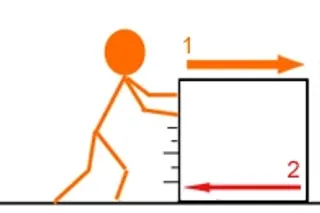
1. force > static friction
The force (arrow 1) overcomes the static friction (arrow 2).
The carton starts to move.
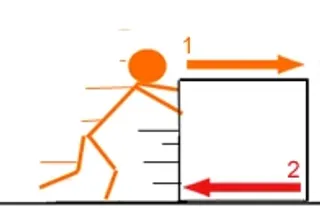
2. force = static friction
The static friction becomes sliding friction (arrow 2) and the carton slides quickly.
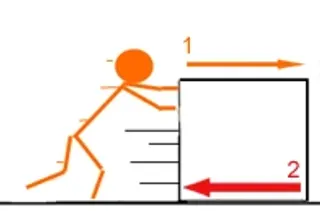
3. force < sliding friction
The force (arrow 1) is not sufficient to overcome the sliding friction (arrow 2).
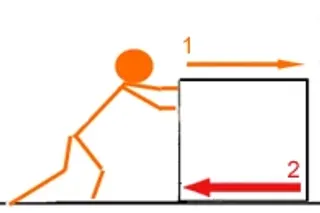
4. force < static friction
The sliding friction becomes static friction. The force is not sufficient, the carton stops.
This phenomenon can be seen in a wide variety of areas. Wipers stutter over the windscreen of a car. When writing on the blackboard, chalk squeaks if you keep it at the wrong angle. Door hinges squeak. And stringed instruments such as the violin or the cello would not work, because their sounds arise by vibrations caused by stick-slip effect and vibration between the strings and the chords of the bows.
For tribologically optimised materials, however, this effect is undesirable. The vibrations caused are transmitted to the overall structure and result in noises, which are often perceived as annoying squeaking or creaking. The desired sliding movement becomes an irregular stuttering and increases the wear of the bearings. These effects can be counteracted by minimising the difference between sliding and static friction, by using vibration-dampening materials, by improving the rigidity of the overall structure (see pre-loaded bearings) or by separating the involved friction partners (for example by lubrication).
Consulting
I look forward to answering your questions

Shipping and consultation
In person:
Monday to Friday from 7 am - 17 pm.
Online:
24h
WhatsApp-Service:
Monday - Friday: 9am - 5:30pm