Change Language :
Glands
What is a cable gland?
A cable gland, also known as a compression gland or cable entry, feeds cables into the housing in a sealed and strain-relieved manner. Enclosures include, e.g. connector, terminal box or control cabinet, control panel, jib box, crane hook or wiring boxes. A cable gland ensures a secure seal of the cable at the passage through a side wall or sheet metal plate into the terminal compartment. Furthermore, it ensures the protection of the control cabinet against external influences (e.g. dust or moisture). Depending on the field of application and environmental influences, further specifications, such as electromagnetic compatibility or ATEX approvals for explosion-proof areas, must be taken into account.
In addition to sealing and strain relief of the cable via cable glands, special anti-kink sleeves offer protection against buckling of the cable. A cable gland therefore protects the electrical equipment itself and also ensures that cables connected to a control cabinet retain their full functionality.
Which cable glands does igus offer?


What you need to know
The two thread types
Nowadays, metric threads according to DIN EN 60423 are mostly used. In addition to metric threads, PG cable glands (steel conduit threads) according to DIN EN 62444 are used in some exceptional cases, mostly in older applications where conversions, repairs, or retrofits are carried out. For all cable glands, there are corresponding extensions or reductions to adapt the gland to any existing threads. If the cable gland is installed in a through-hole instead of a thread, it must be locked with a corresponding locknut.
The three materials
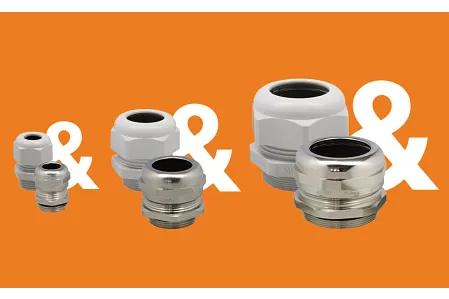
Cable glands are available in various qualities. The three common options include: plastic, brass (or nickel-plated brass) and stainless steel. These materials can be combined with sealing inserts made of various materials and adapted to the cable diameter as well as the operating conditions and external influences. For moulded seals, elastomers such as nitrile butadiene rubber (NBR), fluoroelastomer (FPM), or silicone (VMQ) are suitable options.
Why stainless steel?
In chemical engineering as well as in the food industry, cable glands made of stainless steel (INOX AISI 303) are used. For hygienic and health-related reasons, or due to the use of partially aggressive cleaning agents and chemicals in these two industries, the use of stainless steel is mandatory. Stainless steel is a resistant material and withstands external influences particularly well. Depending on the application, other factors should be taken into account in addition to the suitable material.
How to choose the right cable gland?
Thread size
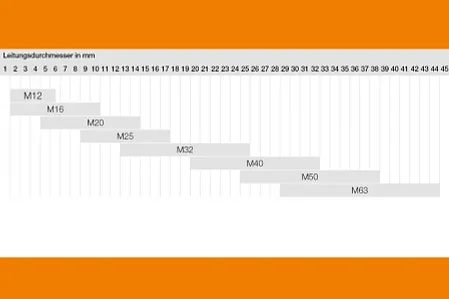
To combine the various cable diameters with the thread size intended for the cable gland, the glands are divided into different clamping ranges. The metric dimension (M) forms the nominal size for cable glands in combination with subsequent digits for the thread size.
The following table helps you to choose the right cable gland:
External influences
Cable glands can be used in a wide variety of environments – the external influences acting on the cables and the gland vary accordingly.
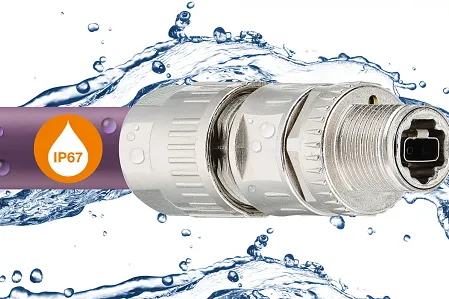
In certain application areas, the screw connections are exposed to moisture or water. In this case, the connector must have an appropriate ingress protection rating to prevent moisture or water from entering the housing. Depending on the area of application, protection against contact and foreign bodies should also be taken into account. The info page on protection ratings provides more detailed information on which protection rating is suitable for which application area.
Material
Depending on the type of external influences to which the cable gland is exposed, it is important to select a material for the screw connection that is suitable for the application area.
As previously described, stainless steel cable glands are used in the food and chemical industries. Due to its resistance to external influences, stainless steel is not only particularly suitable here, but also mandatory.
Brass cable glands are usually used in so-called "hazardous areas", which are present, e.g. in the oil and gas industry.
Cable glands with the material specification "nickel-plated brass" are often found in demanding, harsh industrial applications. They are also available in an electromagnetic compatibility compliant version with a special shielding concept.
Plastic cable glands made of polyvinyl chloride (PVC), polyvinylidene fluoride (PVDF) or polyamide (PA) are also used in industry depending on the application and environmental conditions.
Customised inserts for cable gland

Consulting
I look forward to answering your questions

Shipping and consultation
In person:
Monday to Friday from 7 am - 17 pm.
Online:
24h
WhatsApp-Service:
Monday - Friday: 9am - 5:30pm